


Gratitude is one of the easiest ways to build stronger relationships, and few phrases do it as effortlessly as “thank you both.” Whether you’re wrapping up an email to two colleagues, thanking a couple for hosting dinner, or acknowledging two people who helped you finish a project, this small phrase carries a lot of warmth.
In this guide, you’ll learn exactly what “thank you both” means, how to use it correctly, when to avoid it, and which alternatives work best in different situations. By the end, you’ll be able to use this phrase — and its synonyms — with total confidence.
What Does Thank You Both Mean?
“Thank you both” is a simple expression used to show gratitude toward two people at the same time. Instead of thanking each person separately, this phrase combines the appreciation into one clear, polite statement.
For example:
- “Thank you both for coming to my birthday party.”
- “Thank you both for your support during the project.”
The phrase works because it:
- Acknowledges both people equally, without favoritism
- Saves time compared to thanking each person individually
- Feels warm, sincere, and natural in speech or writing
- Fits both casual and professional communication
It’s important to note that “thank you both” is meant strictly for two individuals. If you’re addressing three or more people, “thank you all” is the more accurate choice.
Alternatives to Thank You Both

While “thank you both” is perfectly fine on its own, using different expressions keeps your communication fresh and avoids sounding repetitive — especially in emails, speeches, or written messages where the phrase might come up more than once.
Here are some of the best alternatives, along with when to use them.
Thanks to Both of You Quotes
This version places slight emphasis on the outcome or result caused by both people’s efforts, rather than the act of thanking itself.
Examples:
- “The event was a success thanks to both of you.”
- “Thanks to both of you, we finished the report ahead of schedule.”
- “I passed the exam thanks to both of you.”
Notice that this phrasing usually needs a supporting clause — it rarely stands alone as a complete sentence.
I Appreciate Both of You
This alternative feels more personal and emotional. It works well when you want to highlight the value of the relationship, not just a specific action.
Examples:
- “I appreciate both of you more than words can say.”
- “I appreciate both of you for always being there for me.”
I’m Grateful to You Both
This version leans slightly more formal and heartfelt, often used in personal messages, speeches, or thank-you cards.
Examples:
- “I’m grateful to you both for your patience and guidance.”
- “I’m grateful to you both for standing by me through this.”
Thank You Both Synonyms
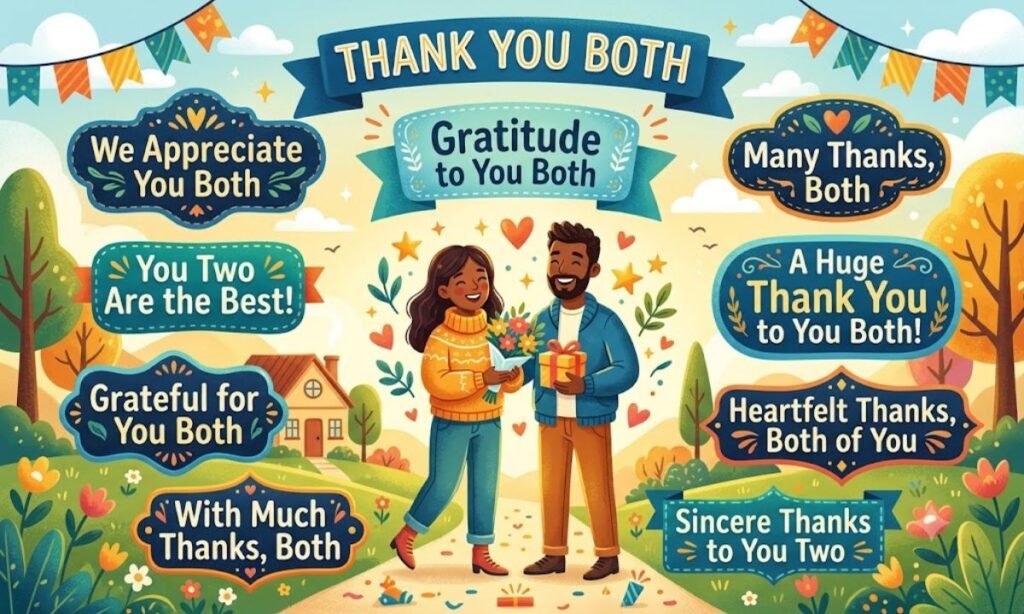
Below is a quick-reference table of synonyms you can rotate depending on tone and context.
| Synonym Phrase | Best Used In |
| Thanks to both of you | Written messages, results-based thanks |
| I appreciate both of you | Casual or emotional conversations |
| I’m grateful to you both | Formal or heartfelt messages |
| Many thanks to you both | Professional emails, British English |
| My sincere thanks to both of you | Formal letters, speeches |
| Much appreciated, both of you | Informal, friendly tone |
Many Thanks to You Both
This is a slightly more formal variation, often preferred in written communication such as emails or professional letters. It’s especially common in British English.
Examples:
- “Many thanks to you both for your continued support.”
- “Many thanks to you both for making time for this meeting.”
Is It Correct to Say Thank You Both?
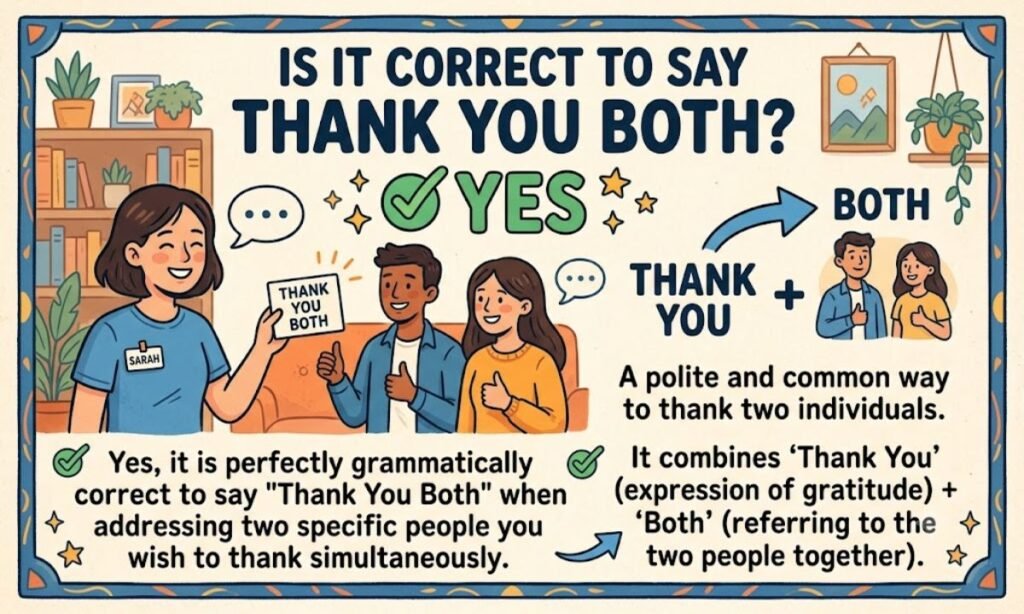
Yes — “thank you both” is grammatically correct and widely accepted in both spoken and written English. It functions as a shortened way of saying “thank you, both of you,” and native speakers use it naturally in everyday conversation.
A few grammar notes worth remembering:
- Use “thank you both” only when addressing exactly two people.
- For three or more people, switch to “thank you all” or “thank you everyone.”
- Avoid combining it incorrectly, such as saying “thank you for both of you” — this is grammatically awkward and should be avoided.
- “Thanks to both of you” is different from “thank you both” — the first implies a result or cause, while the second is a direct expression of gratitude.
Why Thank You Both Matters in Communication
Small phrases like “thank you both” play a bigger role in communication than most people realize. Here’s why it matters:
- Builds stronger relationships – Acknowledging two people together shows you value their combined effort, not just one person’s contribution.
- Prevents favoritism – Thanking one person and forgetting the other can feel dismissive. This phrase keeps things balanced.
- Improves professionalism – In workplace emails, thanking two collaborators together shows attentiveness and good communication skills.
- Adds emotional warmth – In personal settings, it makes the recipients feel equally appreciated and seen.
- Keeps messages concise – Instead of writing two separate thank-you notes, one phrase does the job efficiently.
Whether it’s a wedding toast, a work email, or a text to your parents, using “thank you both” correctly makes your gratitude feel genuine and intentional.
Common Mistakes to Avoid When Using Thank You Both
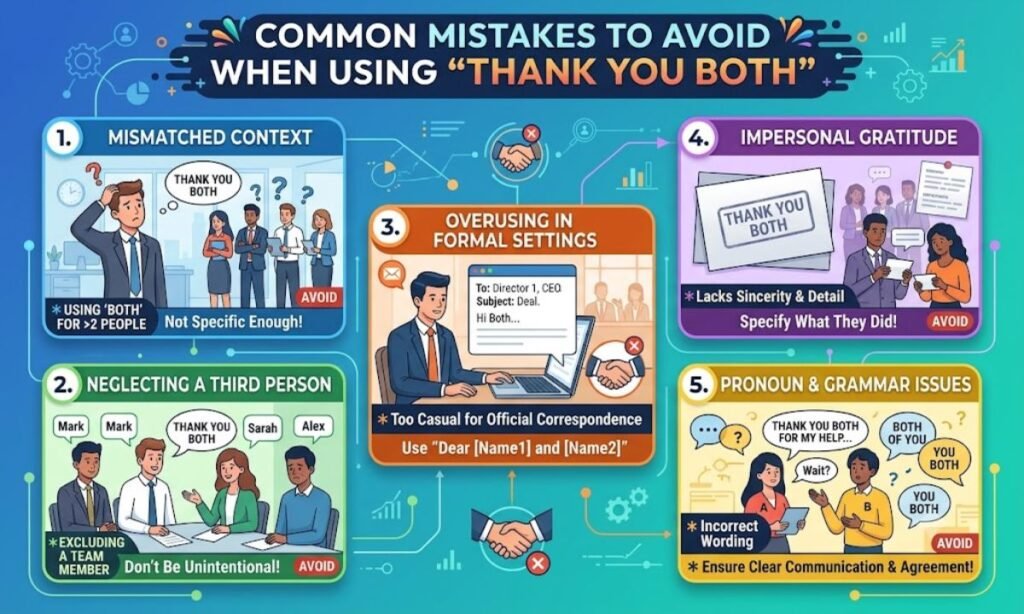
Even though the phrase is simple, people often misuse it. Here are the most common mistakes:
| Mistake | Correction |
| “Thank you both” used for 3+ people | Use “thank you all” instead |
| “Thank you for both of you” | Say “thank you both” or “thank you to both of you” |
| “Thank to both of you” | Correct form is “thanks to both of you” (with an “s”) |
| Overusing the phrase repeatedly in one message | Rotate with synonyms like “I appreciate both of you” |
| Using “thanks to both of you” as a direct spoken thank-you | Use “thank you both” instead — it sounds more natural in speech |
Thank You Both Comma

A common question is whether a comma is needed after “thank you both.” The answer depends on what follows:
- If followed by a name or direct address, use a comma: “Thank you both, Sarah and Alex.”
- If followed directly by a reason, no comma is needed: “Thank you both for your help.”
- If starting a sentence with a greeting before it, use a comma: “Hi Sarah, thank you both for coming.”
In most everyday sentences, no comma is required directly after “thank you both” when it’s followed by “for.”
conclusion
“Thank you both” is a short but powerful phrase that shows equal appreciation to two people at once. It’s grammatically correct, versatile, and appropriate for both personal and professional settings. By understanding when to use it — and when to switch to alternatives like “thanks to both of you,” “I appreciate both of you,” or “many thanks to you both” — you can express gratitude naturally in any situation.
The key takeaway: use “thank you both” for exactly two people, keep your tone genuine, and don’t be afraid to mix in synonyms to keep your communication fresh and sincere.
Frequently Asked Questions
Is “thank you both” grammatically correct?
Yes, it is fully correct and commonly used in both spoken and written English to thank two people at once.
Can I use “thank you both” for more than two people?
No, it should only be used for exactly two people. For larger groups, use “thank you all” instead.
What’s the difference between “thank you both” and “thanks to both of you”?
“Thank you both” directly expresses gratitude, while “thanks to both of you” usually explains a result caused by both people.
Is “thanks to both of you” a complete sentence?
Not usually. It typically needs a following clause to explain what happened as a result of their help.
Can I say “thank you both” in a formal email?
Yes, it works well in professional emails, though “many thanks to you both” adds a slightly more formal tone.
Do I need a comma after “thank you both”?
Generally no, especially when followed by “for” and a reason, such as “Thank you both for your support.”

About MeaningsRoot.com
At MeaningsRoot, we make words easy to understand. Our mission is to explain meanings, slang, phrases, and language concepts in simple, accurate, and reader-friendly articles that help you learn with confidence.