

If you’ve spotted “SYFM” pop up in a text thread, a TikTok comment, or a group chat and immediately felt lost, you’re not alone. Internet slang moves fast, and acronyms like this one tend to spread across platforms before most people ever get a clear explanation of what they actually mean. This guide breaks down everything you need to know about SYFM — its real definition, where it came from, how it’s used across different apps, and when you should probably steer clear of it altogether.
What Does SYFM Mean?
SYFM stands for “Shut Your F*ing Mouth.”** It’s a blunt, profanity-based acronym typically used to tell someone to stop talking, often in the middle of an argument, a shocking reveal, or an over-the-top reaction to something someone just said.
At its core, SYFM carries an aggressive tone. But like a lot of modern internet shorthand, the actual meaning behind it shifts depending on who’s saying it, who they’re saying it to, and what’s going on in the conversation. Between close friends, it can come across as a joking, exaggerated reaction. In a heated exchange with a stranger, the same three letters can feel like a genuine insult.
That dual nature — harsh wording paired with a sometimes-playful delivery — is exactly why so many people search for clarity on what SYFM really means before using it themselves.
The Origin of SYFM

Like most texting acronyms, SYFM wasn’t invented by one person or platform. It grew out of the broader trend of shortening blunt, emotionally charged phrases into quick-to-type letters — a habit that’s shaped internet slang for decades.
Acronyms built around telling someone to be quiet have circulated in online spaces for a long time, with SYFM following a similar path to well-known relatives like STFU. It gained early traction in:
- Gaming chats and voice comms, where fast-paced trash talk and reactions favor short, punchy phrases
- Forums and early chatrooms, where abbreviations helped speed up back-and-forth conversation
- Social media comment sections, where character limits and quick scrolling reward brevity
By the time short-form video platforms took off, SYFM had already been absorbed into everyday youth slang, showing up in captions, comments, and reaction videos as a stand-in for genuine shock or disbelief — not just anger.
Syfm Meaning in Text Instagram
On Instagram, SYFM usually shows up in comments or DMs as a reaction to something surprising, dramatic, or funny — not necessarily hostile. You’ll see it dropped under a wild story update, a plot twist in a reel, or an unexpected announcement from a friend. In this setting, it functions more like “no way” or “I can’t believe you just said that” than an actual demand for silence.
SYFM Meaning in Text Messages
In one-on-one texting, SYFM’s meaning depends heavily on context. Here’s a quick breakdown of how tone shifts the interpretation:
| Context | Likely Meaning | Tone |
| Close friend shares wild gossip | “No way, tell me more” | Playful, shocked |
| Someone is annoying you in an argument | Genuine “be quiet” | Aggressive, rude |
| Reaction to a joke or roast | “Okay that’s savage” | Humorous |
| Sarcastic response to an obvious statement | “Duh, I know” | Sarcastic |
| Text from a stranger during conflict | Hostile demand to stop talking | Confrontational |
Because the phrase includes profanity, it’s rarely appropriate in formal or professional texting. It lives almost entirely in casual, informal conversations between people who already have an established rapport.
How SYFM Is Used on Social Media
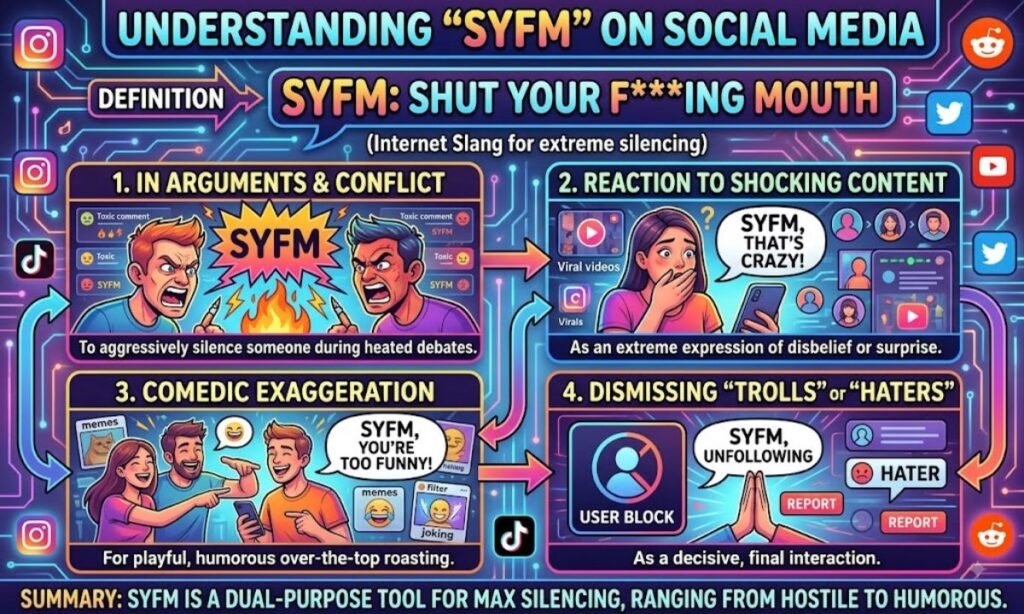
Social media is where SYFM sees the heaviest use, largely because comment sections thrive on quick, reactive language. Common social platforms where you’ll spot it include:
- TikTok — as a comment reacting to a shocking video or unexpected ending
- Twitter/X — as a quick-fire response to breaking news, drama, or a bold opinion
- Snapchat — in quick chat replies reacting to a story or snap
- Instagram — in comment threads and DMs reacting to big reveals
On most of these platforms, SYFM functions less like a literal command and more like a stylized exclamation — similar to saying “shut up!” in real life when you’re genuinely shocked rather than annoyed.
SYFM in Online Gaming
Gaming communities were among the earliest adopters of blunt, fast-typed acronyms, and SYFM fits right into that culture. In voice chat or text chat during matches, it typically appears in two main ways:
- As trash talk — directed at an opposing player after a bold play or a lucky win
- As banter among teammates — used jokingly after someone makes a big claim or brags about a play
Gaming chat tends to normalize harsher language faster than other spaces, so SYFM often loses some of its bite there and reads more like competitive banter than a genuine insult.
SYFM Meaning in a Good Way
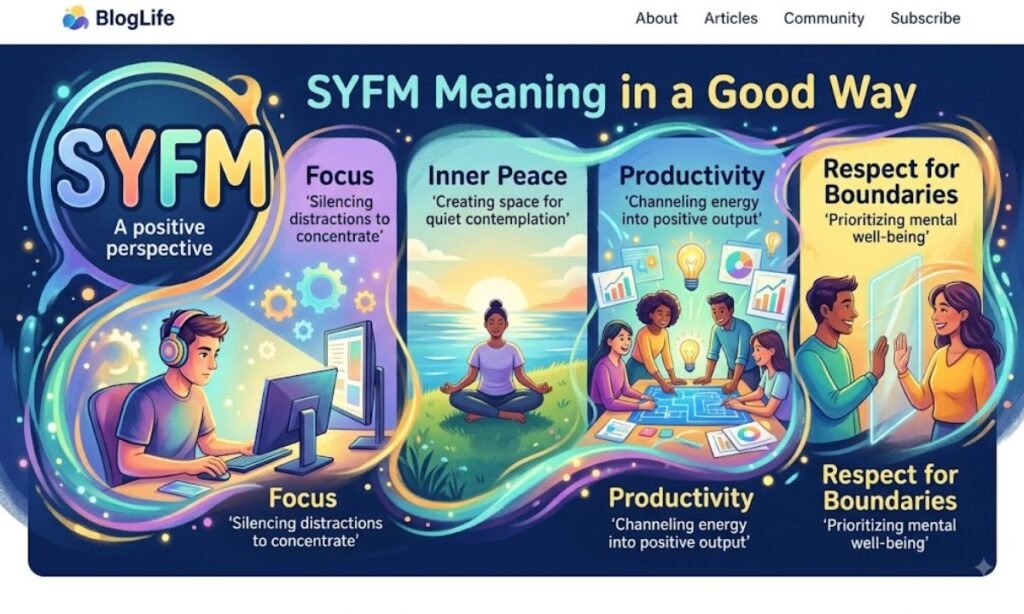
Despite its rough wording, SYFM is frequently used in a positive or lighthearted sense. When used “in a good way,” it typically signals:
- Genuine excitement or disbelief (“Wait, SYFM, that’s amazing news!”)
- Playful shock among friends who trust each other’s tone
- An exaggerated, comedic reaction rather than a literal command
This is one of the more confusing parts of the acronym for people encountering it for the first time — the words sound harsh, but the intended emotion is often closer to enthusiasm than hostility.
SYFM in Group Chats
Group chats are a natural home for SYFM because they’re fast-moving, informal, and full of reactions to whatever someone just shared. In this setting, it commonly shows up as a response to:
- Someone dropping unexpected news (a breakup, a new job, a big life update)
- A funny or embarrassing story
- A hot take that stirs up reactions from the whole group
Because everyone in a group chat usually shares some level of familiarity, the phrase tends to read as reactive slang rather than a genuine insult — though this isn’t guaranteed, especially in larger or more mixed group chats where not everyone knows each other well.
Is SYFM Offensive?
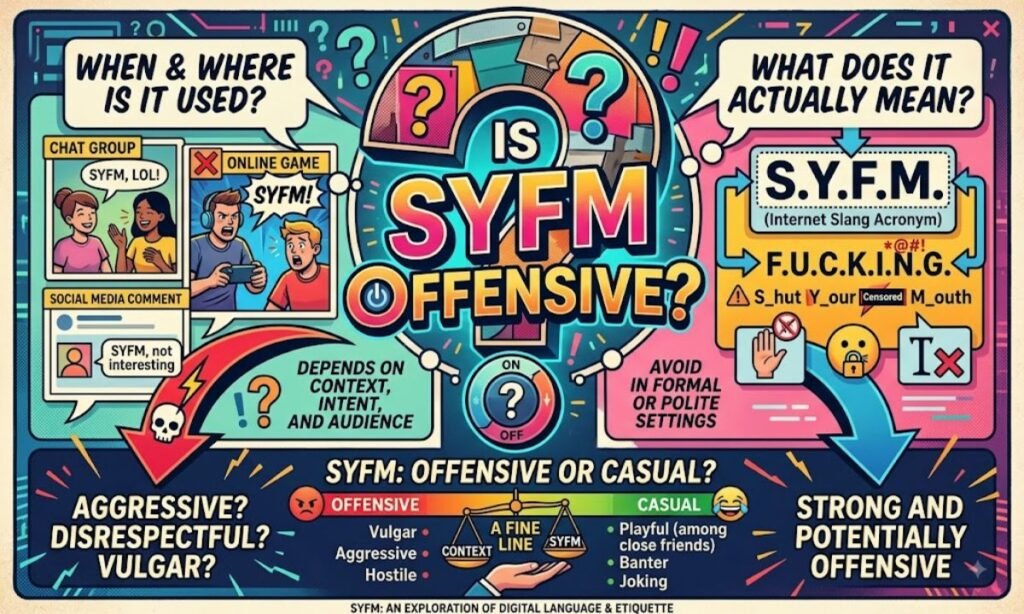
Yes, SYFM can absolutely be offensive — it depends entirely on context, relationship, and delivery. Because it contains profanity and is literally a command to stop talking, it carries the potential for rudeness even when it isn’t meant that way.
Factors that determine offensiveness:
- Relationship — close friends have more leeway than acquaintances or strangers
- Tone indicators — emojis, capitalization, and punctuation help clarify intent
- Setting — playful in gaming chats or group texts, riskier in formal or professional spaces
- Prior conversation — a joke earlier in the exchange makes the phrase read as playful; tension makes it read as hostile
When in doubt, it’s safer to assume the recipient might take it literally, especially over text where tone is easy to misread.
When Should You Avoid Using SYFM?
There are several situations where using SYFM is a bad idea, regardless of intent. Avoid it when:
- Talking to someone you don’t know well
- Messaging in a professional or work-related chat
- The conversation already has tension or conflict
- You’re unsure how the other person will interpret blunt language
- You’re texting someone significantly older or younger than you, especially in a family setting
Using profanity-based slang in the wrong context can escalate misunderstandings quickly, so it’s worth pausing before sending it in anything other than a clearly casual, familiar exchange.
Why People Use Internet Slang Like SYFM
Slang like SYFM exists because digital communication rewards speed and emotional punch. A few reasons this kind of acronym keeps spreading:
- Efficiency — typing three letters is faster than a full sentence
- Emotional intensity — blunt phrasing conveys strong reactions quickly
- In-group identity — using current slang signals familiarity with online culture
- Trend cycles — short-form video platforms accelerate how fast new terms spread
- Humor — exaggerated, harsh-sounding phrases often land as funny rather than serious
This pattern isn’t unique to SYFM — it mirrors how earlier acronyms like SMH, FML, and STFU became embedded in everyday digital conversation.
SYFM Meaning Urban Dictionary

Crowdsourced slang dictionaries generally define SYFM the same way most online sources do: “Shut Your F***ing Mouth.” User-submitted definitions on these platforms tend to emphasize the phrase’s dual usage — some entries frame it strictly as an aggressive insult, while others note its common use as an exaggerated, joking reaction among friends. As with most user-generated slang references, definitions can vary slightly depending on who submitted them, but the core meaning stays consistent across sources.
SYFM vs Other Popular Internet Acronyms
Here’s how SYFM stacks up against a few similar acronyms people often confuse it with:
| Acronym | Meaning | Typical Tone |
| SYFM | Shut Your F***ing Mouth | Aggressive or playful, depending on context |
| STFU | Shut The F*** Up | Usually more direct and forceful |
| SMH | Shaking My Head | Disapproval or disbelief, non-aggressive |
| FML | F*** My Life | Frustration or self-deprecating humor |
| SYBAU | Shut Your B**** Ass Up | Harsher, more confrontational |
SYFM sits somewhere in the middle of this group — more intense than SMH, but generally less harsh than SYBAU, with its exact tone shifting based on who’s using it.
SYFM Used Playfully Between Friends

Among close friends, SYFM often functions as a form of affectionate teasing. Typical scenarios include:
- Reacting to a friend’s unbelievable story with “SYFM, no way”
- Responding to a joke that catches you off guard
- Playfully “silencing” a friend who’s exaggerating or bragging
In these cases, the phrase works almost like a compliment disguised as an insult — a way of saying “I’m shocked in a good way” without sounding sincere or soft.
Examples of SYFM in Everyday Conversations
Here are a few sample exchanges showing how SYFM shows up in real conversations:
Example 1 — Shocking news
Friend: “I just got accepted into my dream school!”
You: “SYFM!! No way, congratulations!”
Example 2 — Playful banter
Friend: “I definitely could’ve beaten you in that game.”
You: “SYFM, you lost by 20 points.”
Example 3 — Heated conflict
Stranger: “You have no idea what you’re talking about.”
Response: “SYFM.” (comes across as hostile)
Example 4 — Gossip reaction
Friend: “Guess who just got engaged?”
You: “SYFM, tell me everything right now.”
These examples highlight just how much the surrounding conversation shapes whether SYFM reads as fun or offensive.
Final Words
SYFM is a good example of how modern internet slang can carry two very different meanings depending entirely on context. While it technically stands for a rude, profanity-loaded phrase, its actual use ranges from aggressive confrontation to lighthearted, joking disbelief among friends. Before using it yourself, take a moment to consider your relationship with the recipient, the tone of the conversation, and the platform you’re on. When used carelessly, it risks sounding harsh or disrespectful — but used correctly among the right audience, it’s just another piece of expressive shorthand in the ever-evolving world of digital slang.
Frequently Asked Questions
What does SYFM mean in texting?
SYFM stands for “Shut Your F***ing Mouth,” typically used to react to shocking news or to tell someone to stop talking.
Is SYFM always meant to be offensive?
No, it’s often used playfully among friends to express disbelief or excitement rather than genuine anger.
Where did SYFM originate?
It grew out of online gaming chats, forums, and social media culture as a shortened way to express strong reactions.

About MeaningsRoot.com
At MeaningsRoot, we make words easy to understand. Our mission is to explain meanings, slang, phrases, and language concepts in simple, accurate, and reader-friendly articles that help you learn with confidence.