


Introduction
The letter Z sits at the very end of the alphabet, but it holds some of the most interesting terms in science. From crystal structures used in laundry detergents to catalysts that revolutionized plastic manufacturing, science words that start with Z span chemistry, physics, biology, and anatomy.
Because Z is rarely used in English or in the Greek and Latin roots most scientific vocabulary comes from, finding a solid list of Z science words can be tricky. This guide fixes that. Below, you’ll find a clear, easy-to-understand breakdown of 16 important science words that start with Z, complete with real-world examples, simple explanations, and a quick-reference table for fast learning.
Whether you’re a student prepping for an exam, a chemistry enthusiast, or just curious about scientific vocabulary, this list will help you understand what these terms mean and why they matter.
Quick Reference: Science Words That Start With Z
| Word | Field | Simple Meaning |
| Zeolite | Chemistry/Geology | Porous mineral used as a catalyst and filter |
| Zwitterion | Chemistry | Molecule with both positive and negative charges |
| Zircon | Geology | Hard, durable mineral used for dating rocks |
| Zero Order Reaction | Chemistry | Reaction rate independent of reactant concentration |
| Zeeman Effect | Physics | Splitting of spectral lines in a magnetic field |
| Zymase | Biochemistry | Enzyme complex that ferments sugar into alcohol |
| Zeolitic Water | Chemistry | Water trapped in a zeolite’s crystal structure |
| Ziegler–Natta Catalyst | Chemistry | Catalyst used to make polymers like plastic |
| Zirconocene | Organometallic Chemistry | Zirconium-based compound used in catalysis |
| Zincate | Chemistry | Compound containing a zinc-oxygen ion |
| Zusammen | Organic Chemistry | Term describing molecular configuration (Z-isomer) |
| Zeta Potential | Chemistry/Physics | Electric charge at a particle’s surface |
| Zone Refining | Materials Science | Purification method for metals and crystals |
| Zymurgy | Biochemistry | The science of fermentation |
| Z-Axis | Physics/Math | The third dimension in 3D coordinate systems |
| Zygomatic Arch | Anatomy | Bony arch that forms the cheekbone structure |
Now let’s look at each of these terms in more detail.
Chemistry Terms That Start With Z
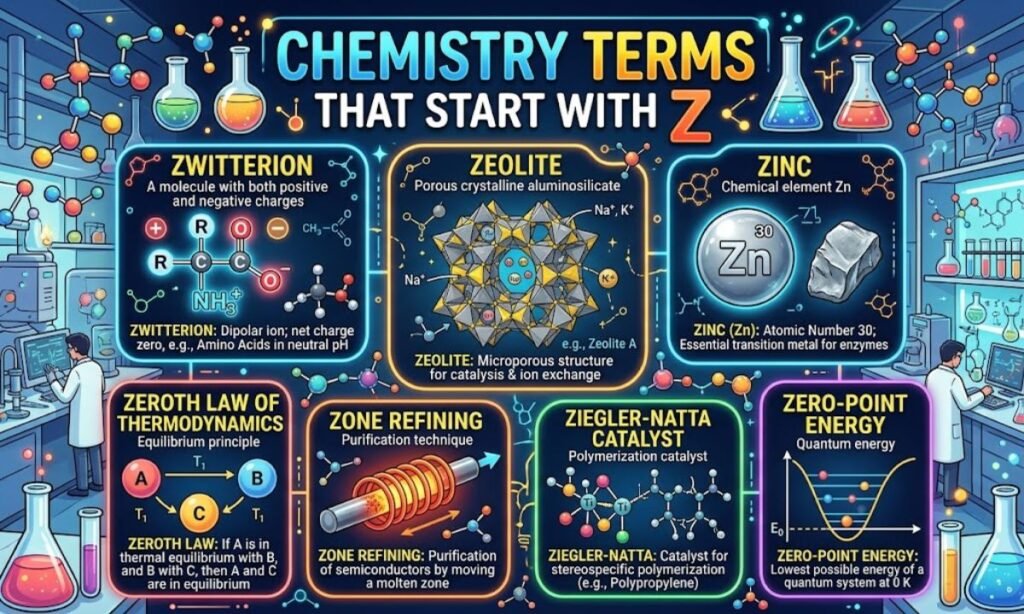
Chemistry contributes the largest share of Z science words, covering everything from catalysts to crystal structures.
Zeolite
Zeolites are microporous, crystalline minerals made of aluminum, silicon, and oxygen, arranged in a honeycomb-like framework of tiny cavities and channels. This structure gives zeolites a huge internal surface area relative to their size.
Because of their porous nature, zeolites are widely used as:
- Molecular sieves that filter substances by particle size
- Water softeners in laundry detergents
- Catalysts in oil refining and petrochemical processes
- Odor absorbers and gas purifiers
Both natural and synthetic zeolites exist, with over 200 synthetic types engineered for specific industrial uses.
Zwitterion
A zwitterion is a molecule that carries both a positive and a negative electrical charge at the same time, making its overall net charge neutral. This happens when a molecule has one group that loses a proton (becoming negative) and another group that gains a proton (becoming positive).
Amino acids are the most common example. In water, an amino acid’s amine group becomes positively charged while its carboxyl group becomes negatively charged, forming a zwitterion. This dual-charge property affects solubility, melting point, and how the molecule behaves in biological systems.
Zircon
Zircon is a naturally occurring mineral composed of zirconium silicate. It’s extremely hard, chemically stable, and resistant to weathering, which makes it one of the most useful minerals for geologists.
Key facts about zircon:
- It can survive geological processes that destroy other minerals
- Scientists use it for radiometric dating, since it contains trace uranium that decays at a known rate
- Some zircon crystals found on Earth are over 4 billion years old
- It’s also cut and polished as a gemstone, often mistaken for diamond due to its brilliance
Zero Order Reaction
A zero order reaction is a chemical reaction whose rate does not depend on the concentration of the reactants involved. In simple terms, no matter how much reactant is present, the reaction proceeds at the same constant speed.
This typically happens when a reaction is limited by something other than concentration, such as:
- The surface area of a catalyst
- Available light in a photochemical reaction
- Enzyme saturation in biological systems
Zero order kinetics are common in certain drug metabolism processes and catalytic surface reactions.
Zeolitic Water
Zeolitic water refers to water molecules that are physically trapped within the pore structure of a zeolite crystal, rather than being chemically bonded to it. Unlike water of crystallization, zeolitic water can be removed by gentle heating without destroying the mineral’s overall framework, and the zeolite can later reabsorb water from its surroundings.
This reversible water-holding ability is exactly why zeolites work so well as desiccants and molecular sieves.
Ziegler–Natta Catalyst
The Ziegler–Natta catalyst is a type of catalyst used to produce polymers such as polyethylene and polypropylene with a controlled, orderly molecular structure. Developed by chemists Karl Ziegler and Giulio Natta in the 1950s, this discovery earned them the Nobel Prize in Chemistry in 1963.
Why it matters:
- It allows plastics to be produced with specific physical properties (strength, flexibility, heat resistance)
- It made large-scale, cost-effective plastic manufacturing possible
- It’s still used today in the production of many everyday plastics
Zirconocene
Zirconocene is an organometallic compound in which a zirconium atom is bonded to two cyclopentadienyl rings, forming a sandwich-like structure. It belongs to a class of compounds called metallocenes.
Zirconocene compounds are important in:
- Catalyzing polymerization reactions (similar in purpose to Ziegler-Natta catalysts)
- Organic synthesis, where they help form carbon-carbon bonds
- Research into new materials and pharmaceuticals
Zincate
A zincate is a chemical compound containing a negatively charged ion made of zinc and oxygen, typically written as ZnO₂²⁻ or Zn(OH)₄²⁻. Zincates form when zinc oxide or zinc hydroxide dissolves in a strong alkaline (basic) solution.
Zincates are relevant in:
- Battery chemistry, especially in zinc-based batteries
- Electroplating processes
- Corrosion studies of zinc-coated metals
Zusammen
Zusammen (German for “together”) is a term used in organic chemistry to describe the configuration of a double bond in an isomer. When the two higher-priority substituents on a double bond are on the same side, the compound is labeled with a “Z” prefix (from zusammen).
This is part of the E/Z system for naming geometric isomers:
- Z-isomer: higher-priority groups on the same side
- E-isomer: higher-priority groups on opposite sides (from the German “entgegen,” meaning opposite)
This system replaced the older cis/trans naming convention for molecules with more complex substituents.
Zeta Potential
Zeta potential is a measurement of the electric charge that exists at the surface of a particle when it’s suspended in a liquid. It reflects the degree of repulsion or attraction between particles in a solution or colloid.
Zeta potential is important because it helps predict:
- Whether a suspension will remain stable or the particles will clump together
- How a colloid, paint, or pharmaceutical formulation will behave over time
- The effectiveness of water treatment processes that rely on particle separation
Generally, a higher zeta potential (positive or negative) indicates greater stability, since particles repel each other rather than sticking together.
Zone Refining
Zone refining is a purification technique used to produce extremely pure metals or crystals, especially semiconductors like silicon and germanium. The process works by passing a narrow molten zone slowly along a solid bar of material. Impurities tend to dissolve more easily in the liquid phase, so they move along with the molten zone, leaving a purer solid behind it.
This method is critical in:
- Semiconductor manufacturing for computer chips
- Producing ultra-pure metals for scientific research
- Growing high-quality crystals for optical and electronic devices
Biology and Biochemistry Terms That Start With Z
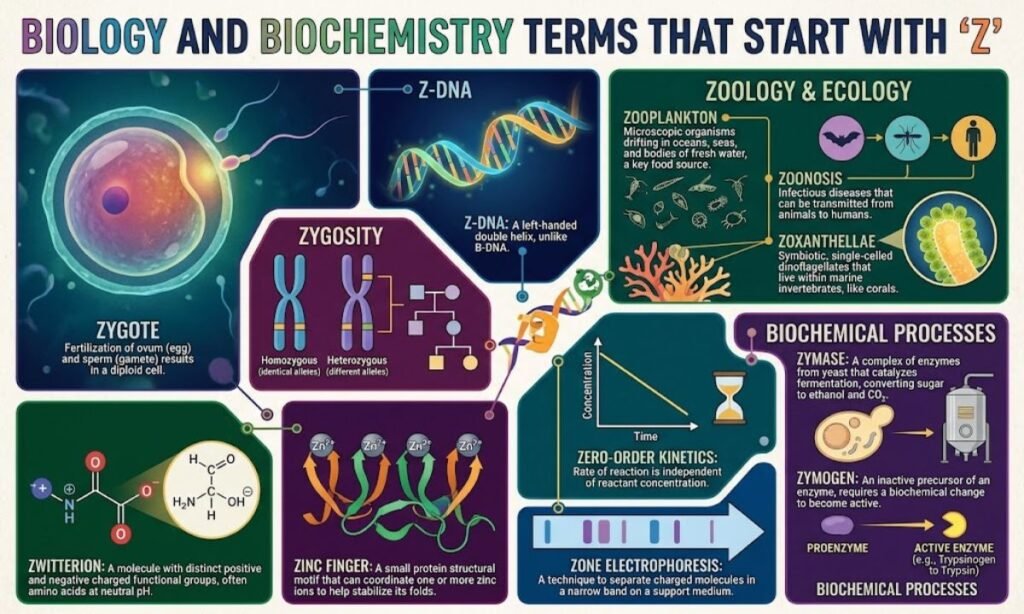
Zymase
Zymase is a complex mixture of enzymes found in yeast that catalyzes the fermentation of sugar into ethanol and carbon dioxide. It was discovered in 1897 by German chemist Eduard Buchner, who proved that fermentation could occur outside living cells, a finding that helped establish the field of biochemistry.
Zymase plays a central role in:
- Brewing beer and making wine
- Baking bread, where the carbon dioxide released causes dough to rise
- Industrial ethanol production
Zymurgy
Zymurgy is the branch of applied science dedicated to the study of fermentation, particularly as it applies to brewing, winemaking, and distilling. It combines principles from chemistry, microbiology, and biochemistry to understand and optimize fermentation processes.
A person who studies or practices zymurgy is sometimes called a zymurgist, and the underlying chemical science of fermentation is known as zymology.
Physics and Math Terms That Start With Z

Zeeman Effect
The Zeeman effect is the splitting of a single spectral line into multiple, closely spaced lines when an atom is placed in an external magnetic field. It was discovered by Dutch physicist Pieter Zeeman in 1896, an achievement that earned him the Nobel Prize in Physics in 1902.
This effect is significant because it:
- Provides evidence for the quantization of angular momentum in atoms
- Helps scientists measure magnetic fields in stars, including the sun
- Is widely used in astrophysics and spectroscopy
Z-Axis
The Z-axis is the third dimension in a three-dimensional coordinate system, typically representing depth or height, perpendicular to both the X-axis (horizontal) and Y-axis (vertical). Together, the three axes allow scientists, engineers, and mathematicians to describe the exact position of a point in 3D space.
The Z-axis is used across many fields, including:
- 3D modeling and computer graphics
- Robotics and CNC machining
- Physics, for describing motion and force in three dimensions
Anatomy Term That Starts With Z

Zygomatic Arch
The zygomatic arch is a bony arch on the side of the skull that forms the structural framework of the cheekbone. It’s created by the joining of the zygomatic bone and a portion of the temporal bone.
The zygomatic arch serves several important functions:
- It protects the temporalis muscle, which is used in chewing
- It provides attachment points for facial muscles
- It contributes to the overall shape and structure of the face
This term frequently appears in anatomy courses, medical imaging, and forensic science, where facial bone structure helps identify skeletal remains.
Why Learning Science Words That Start With Z Matters

Even though Z-words are rare in English, they carry outsized importance in scientific literature. Here’s why building this vocabulary is worth the effort:
- Exam and coursework relevance — Terms like zygote, zeolite, and zero order reaction show up regularly in biology, chemistry, and physics coursework.
- Real-world applications — Words like Ziegler–Natta catalyst and zone refining connect directly to industries like plastics manufacturing and semiconductor production.
- Precision in communication — Scientific terms exist because everyday language often can’t capture a specific process or property with the same accuracy.
- Foundation for advanced study — Many Z-terms, especially in chemistry and physics, form the basis for more advanced concepts studied in higher education and research.
Final Words
Science words that start with Z may be few in number, but they’re rich in meaning. From the porous structure of zeolites to the charge balance in zwitterions, and from the fermentation science of zymurgy to the anatomical precision of the zygomatic arch, these terms reflect just how detailed and interconnected scientific language really is.
Whether you’re studying for an exam, expanding your general knowledge, or simply curious about uncommon scientific vocabulary, this list offers a solid starting point for understanding what these terms mean and where they’re used. Keep this guide handy as a quick reference the next time a Z-word shows up in your textbook, research paper, or casual reading.
Frequently Asked Questions
What are some common science words that start with Z?
Common examples include zeolite, zygote, zinc, zwitterion, zircon, and zeta potential, spanning chemistry, biology, and geology.
Is Z the rarest letter for science vocabulary?
Yes, Z is one of the least common starting letters in English and in Greek/Latin scientific roots, so Z-word lists tend to be shorter than other letters.
What is the difference between zymase and zymogen?
Zymase is an active enzyme complex that ferments sugar, while a zymogen is an inactive enzyme precursor that must be activated first.
Why is the Ziegler–Natta catalyst important?
It enables controlled, large-scale production of plastics like polyethylene and polypropylene, and its discovery won a Nobel Prize in 1963.

About MeaningsRoot.com
At MeaningsRoot, we make words easy to understand. Our mission is to explain meanings, slang, phrases, and language concepts in simple, accurate, and reader-friendly articles that help you learn with confidence.