

Scrolled through your DMs, a group chat, or a TikTok comment section and spotted the letters PTSO? You’re not imagining things — this abbreviation has been popping up more and more across text messages, Instagram comments, and WhatsApp chats. If you’re left wondering what it means and whether you should be worried, flattered, or confused, you’re in the right place.
This guide breaks down everything about PTSO — its meaning, origin, how it’s used, and how to respond when someone drops it into a conversation with you.
What Does PTSO Mean?
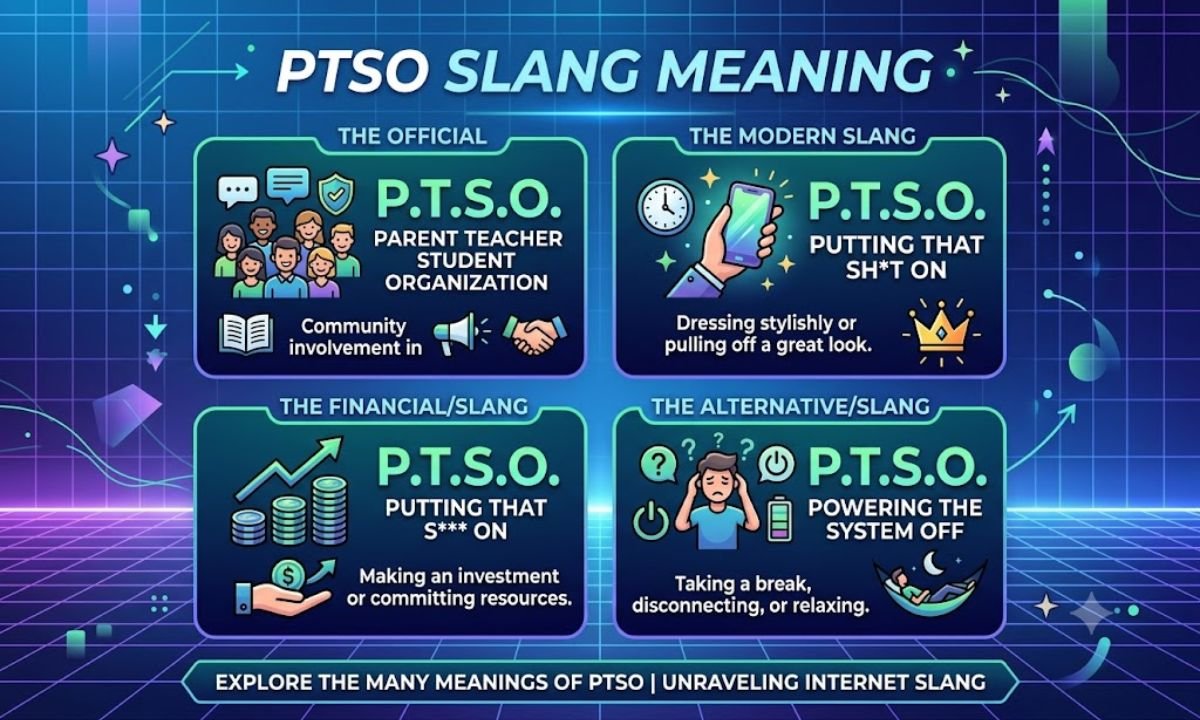
PTSO doesn’t have one single, official definition. It’s internet slang, which means its meaning shifts depending on who’s using it and where. That said, there’s one interpretation that shows up more often than the rest:
PTSO = “Put That Sh*t On”
In this sense, it’s used as a casual compliment about someone’s outfit, style, or overall look. If a friend comments “PTSO 🔥” on your Instagram post, they’re basically saying you look great and you should keep dressing like that.
But that’s not the only meaning floating around. Depending on the chat, PTSO can also stand for:
- Pass That/This Sh*t On — used when someone wants information or a message shared with others
- Please Turn Something On — a quick, practical request (often about a mic, light, or device)
- Prefer To Stay Offline — used when someone wants privacy or space from chatting
- Parent Teacher Student Organization — the formal, non-slang use, common in school communities
The takeaway? PTSO is context-dependent. Before you assume what it means, look at who sent it and what the conversation is about.
Quick Snapshot
| Meaning | Common Setting | Tone |
| Put That Sh*t On | Instagram, TikTok, texting | Compliment/hype |
| Pass That Sh*t On | Group chats, gossip threads | Informal, sharing info |
| Please Turn Something On | Gaming, video calls | Practical request |
| Prefer To Stay Offline | Casual texting | Boundary-setting |
| Parent Teacher Student Organization | School emails, community groups | Formal |
Origins of PTSO

Unlike classic texting abbreviations such as LOL or BRB, PTSO doesn’t have a documented “first use” or a clear inventor. There’s no viral tweet or meme that traces back to its creation.
Instead, it appears to have grown organically out of teen and young-adult texting culture, likely gaining traction in group chats and comment sections before spreading to wider social media use. This is fairly typical for modern slang — a phrase gets used within a smaller circle (friends, gamers, a school community), and if it’s catchy or useful enough, it slowly spreads outward until it becomes recognizable across platforms.
Because it wasn’t coined by one influencer or platform, it’s picked up slightly different meanings in different communities — which explains why you’ll find competing definitions when you search for it.
How to Use PTSO in Texting
Using PTSO correctly comes down to reading the room. Here’s how it typically plays out:
- As a style compliment — Someone posts a new fit or a glow-up photo, and you reply “PTSO!” to hype them up.
- As encouragement — A friend mentions they’re nervous about a date, interview, or performance, and you text back “PTSO, you’ve got this.”
- As a sharing request — In a group chat, someone might say “PTSO” when they want a message, meme, or piece of news forwarded to others.
- As a practical ask — In gaming voice chats or video calls, “PTSO the mic” simply means turn it on.
Example texts:
Friend: Just got this new jacket 🧥
You: PTSO!! That’s such a good look on you.
Group chat: Did you guys see this? PTSO to the rest of the squad.
Why Do People Use Slang Like PTSO?
Slang abbreviations like PTSO exist for a few simple reasons:
- Speed — Typing four letters is faster than a full sentence.
- Insider feel — Using trending slang signals that you’re plugged into current online culture.
- Emotional shorthand — A single acronym can carry hype, encouragement, or humor without needing extra explanation.
- Platform habits — Fast-scrolling apps like TikTok and Instagram reward short, punchy comments over long ones.
This is really no different from how “LOL,” “FOMO,” or “GOAT” became everyday vocabulary. Language online moves fast, and abbreviations are the natural byproduct of that speed.
PTSO vs Similar Acronyms
It helps to see PTSO next to other slang terms people often confuse it with.
| Acronym | Meaning | How It’s Different from PTSO |
| PTFO | Passed The F*** Out | Describes being extremely tired or asleep, not a compliment |
| TBH | To Be Honest | Used to preface an honest opinion, not hype-related |
| GOAT | Greatest Of All Time | Praises overall skill/status, not appearance specifically |
| PTO | Paid Time Off / Please Turn Off | Workplace or device-related, not a fashion compliment |
| PTSD | Post-Traumatic Stress Disorder | A clinical term — completely unrelated to the slang use of PTSO, though the letters look similar |
It’s worth noting that PTSO is sometimes mistyped or confused with PTSD simply because the letters are close. They have nothing to do with each other, and it’s important not to mix up a casual slang term with a real mental health condition.
PTSO Meaning Instagram

On Instagram, PTSO usually shows up in comments under outfit posts, selfies, or “get ready with me” content. It functions almost like a compliment emoji — short, quick, and meant to hype the poster up. You’ll often see it paired with fire emojis (🔥) or heart-eyes.
PTSO Meaning in WhatsApp Chat
In WhatsApp group chats, PTSO leans more toward the “pass this on” meaning. Since WhatsApp is heavily used for forwarding messages, news, and memes among friends and family groups, PTSO here often signals “share this with others.”
PTSO Meaning Slang Urban Dictionary
Crowdsourced slang sites like Urban Dictionary tend to reflect the “Put That Sh*t On” definition most prominently, since that’s the version that gets submitted and upvoted most by younger users. However, because entries are user-submitted, you’ll also find alternate or joke definitions listed there — a reminder that slang dictionaries aren’t always authoritative, just a snapshot of what a particular online community was using at a given time.
PTSO Meaning Gen Z
Among Gen Z texting culture, PTSO fits into a broader pattern of hype-based slang — similar to “ate,” “slay,” or “no cap” — where the goal is quick, expressive encouragement rather than a literal statement. It’s less about grammar and more about tone and energy.
Is PTSO Used Worldwide?
PTSO is most commonly seen in English-speaking online spaces, particularly in the United States, where it appears frequently in texting and social media comments among teens and young adults. It hasn’t reached the same level of global recognition as terms like “LOL” or “OMG,” so:
- In non-English-speaking regions, PTSO is less likely to be understood without explanation.
- Even within English-speaking countries, usage can vary — someone in the UK or Australia may not recognize it the same way a U.S. teen would.
- It remains more of a niche, platform-specific term than a universally understood one.
If you’re texting someone outside your usual online circle, it’s safer to spell out what you mean rather than assume they’ll catch the reference.
Common Mistakes When Using PTSO
- Assuming it always means the same thing. Context is everything — the same four letters can be a compliment, a request, or a boundary statement.
- Using it in professional settings. Because one popular meaning includes mild profanity, PTSO isn’t appropriate for work emails, formal chats, or conversations with people you don’t know well.
- Confusing it with PTSD. Always double-check before typing quickly — these are unrelated terms.
- Overusing it. Like any slang, repeating it constantly can make it feel forced rather than genuine.
- Assuming everyone knows it. Not every friend, coworker, or family member will recognize the term, especially outside younger, terminally-online circles.
Tips for Using PTSO Effectively
- Match the tone of the conversation. Save it for casual, friendly exchanges — not formal or sensitive ones.
- Pair it with emojis or context so the meaning is clear (🔥 for a compliment, 👀 for “pass this on”).
- Know your audience. Close friends and younger social circles are more likely to understand it than coworkers or older relatives.
- Don’t force it. If a term doesn’t come naturally to how you text, it can read as try-hard.
- When in doubt, ask. If someone sends you PTSO and it’s unclear, a quick “what do you mean?” is always fine.
How to Respond When Someone Says PTSO
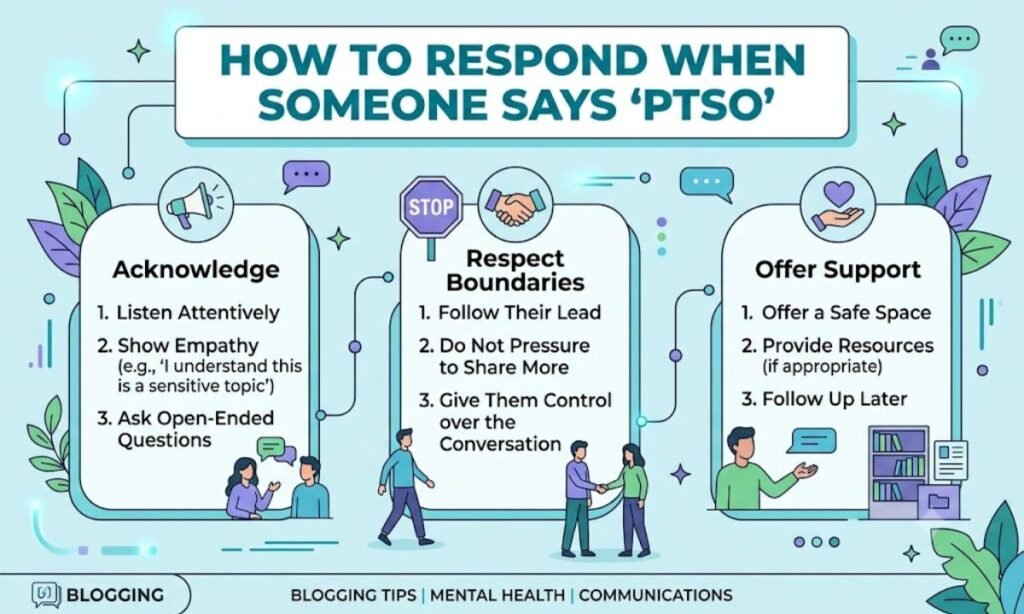
- If it’s used as a compliment: a simple “thank you 😄” or “PTSO right back at you” works well.
- If it’s a request to share something: forward the message or content to the intended people.
- If it’s a practical request (like turning on a mic): just do the action and confirm, e.g., “done, can you hear me now?”
- If you’re unsure of the context: ask directly rather than guessing, especially in a new or unfamiliar chat.
Final Words
PTSO is a good example of how fluid internet slang really is. It doesn’t have one fixed, dictionary-approved meaning — instead, it shifts based on platform, audience, and context, ranging from a stylish compliment to a request to share information to a boundary-setting phrase. The best way to use or interpret it is to pay attention to the conversation around it rather than relying on a single definition.
Slang like this will likely keep evolving, gaining new meanings or fading out as new terms take over — which is exactly how digital language has always worked.
Frequently Asked Questions
What does PTSO mean in text?
It most commonly means “Put That Sh*t On,” used as a casual compliment about someone’s style, though its exact meaning depends on context.
Is PTSO a rude word?
Not typically — it’s usually meant as a compliment or hype phrase, though the full phrase includes mild profanity, so it’s best avoided in formal settings.
Does PTSO always mean the same thing?
No, its meaning can change depending on the platform, the people involved, and the conversation itself.
What’s the difference between PTSO and PTSD?
They’re completely unrelated — PTSO is casual internet slang, while PTSD is a clinical mental health term. The similarity is just in the letters.

About MeaningsRoot.com
At MeaningsRoot, we make words easy to understand. Our mission is to explain meanings, slang, phrases, and language concepts in simple, accurate, and reader-friendly articles that help you learn with confidence.