
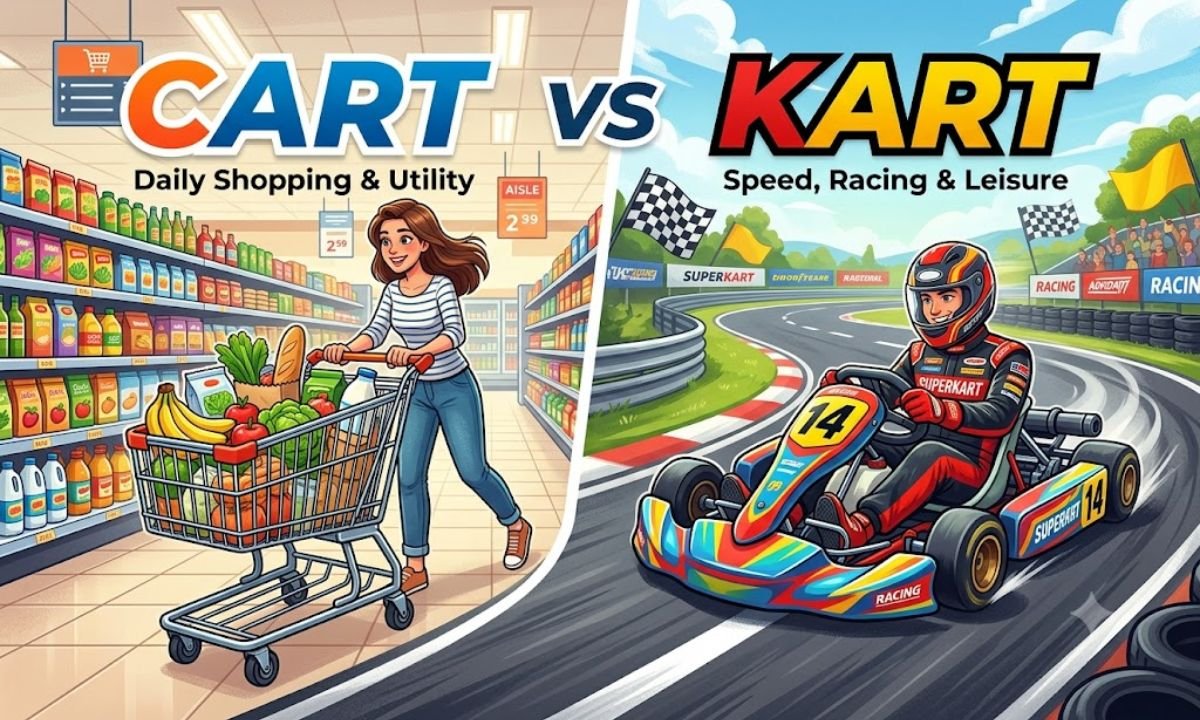

If you’ve ever paused mid-sentence wondering whether you’re pushing a “cart” or a “kart” through the store, you’re not alone. These two words sound exactly alike but mean completely different things. Mixing them up is an easy mistake — and it’s one that can make your writing look careless, especially in professional or SEO content.
This guide breaks down everything you need to know about cart vs kart: their meanings, origins, real-world usage, and simple tricks to remember which one to use every time.
What Does Cart Mean?
A cart is a wheeled vehicle or container used to carry, transport, or store goods and items. It can be pushed, pulled, or towed, and it exists in both physical and digital forms.
Common examples include:
- A shopping cart used in grocery stores
- A golf cart used to move players around a course
- A hand cart or utility cart used to move boxes and equipment
- An online cart where you place items before checking out on a website
In short, whenever something is being carried or collected, “cart” is almost always the correct word.
What Does Kart Mean?
A kart is a small, lightweight, open-wheeled vehicle built for racing or recreational speed. Karts are typically low to the ground, powered by small engines, and used on closed tracks.
The most familiar example is the go-kart, found at amusement parks, racing tracks, and in video games like Mario Kart. “Kart” almost always relates to motorsport, speed, competition, or fun — never to storage or shopping.
Historical Origins of Cart and Kart
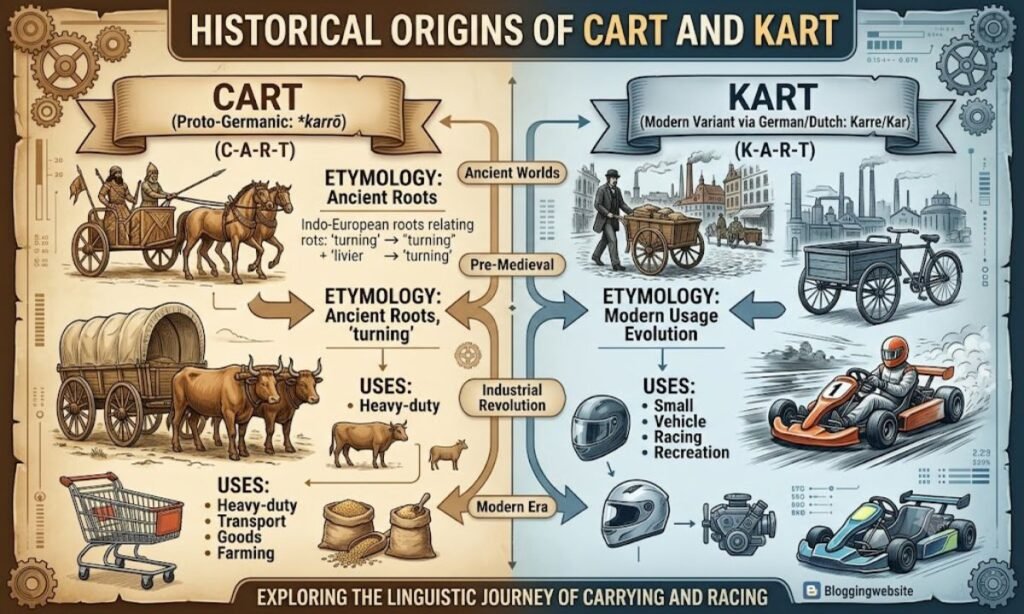
Understanding where these words come from makes the difference much easier to remember.
Cart has ancient roots. It comes from the Old Norse word kartr and the Old English word cræt, both referring to a heavy, wheeled vehicle used to carry loads. Carts have been part of human transportation and trade for centuries, originally pulled by animals like horses and oxen for farming, hauling goods, and even transporting people to markets.
Kart is a modern invention by comparison. The word emerged in the mid-20th century alongside the birth of go-kart racing. In 1956, California machinist Art Ingels is widely credited with building one of the first purpose-built go-karts using a small engine and a lightweight frame. Interestingly, an older spelling, “go-cart” (with a C), had already been used since the 1670s to describe baby walkers — a completely unrelated meaning. To avoid confusion with that older term, the racing community intentionally adopted the “k” spelling, giving the word its own modern, sporty identity.
Cart in Modern Usage
Today, “cart” has expanded far beyond its farming origins. It now applies to almost any object — physical or digital — designed to hold or move items.
Modern examples of “cart” include:
- Shopping cart – used in supermarkets and retail stores
- Online/digital cart – holds items during e-commerce checkout
- Luggage cart – used in hotels and airports
- Medical cart – used in hospitals to carry supplies
- Food cart – a mobile kitchen or vendor stand
- Golf cart – transports players and equipment on a course
Whether it’s made of metal or exists only as a button on a website, a cart always serves the same core purpose: carrying and holding things until they’re ready to be used or purchased.
Kart in Modern Usage
“Kart” today is almost exclusively tied to racing, motorsport, and recreation. You’ll see it used in:
- Go-kart racing – at amusement parks and dedicated tracks
- Karting – the broader sport/hobby of racing small vehicles
- Video games – like Mario Kart, where “kart” refers to the in-game racing vehicles
- Junior motorsport training – karting is often the entry point for young drivers learning to race
Kart Meaning Slang

In casual and gaming conversations, “kart” is sometimes used loosely to describe any small, fast, fun vehicle — even outside formal racing. Gamers use it as shorthand for racing games in general (“let’s play some kart racing”), and it’s occasionally used playfully to describe anything zippy or competitive. This slang usage stays true to the word’s core meaning: speed and fun, never storage or shopping.
Cart vs Kart: Quick Comparison Table
| Feature | Cart | Kart |
| Primary meaning | Vehicle/container for carrying goods | Small vehicle for racing |
| Origin | Old Norse/Old English, ancient | Mid-20th century (1950s) |
| Common settings | Stores, hospitals, e-commerce, farming | Racetracks, amusement parks, video games |
| Powered by | Human, animal, or motor | Small engine (usually) |
| Associated feeling | Practicality, utility | Speed, excitement, competition |
| Example phrase | “Add it to your cart” | “Let’s race go-karts” |
How to Remember the Difference Easily
If you keep mixing them up, try one of these simple memory tricks:
- Cart = Carry. Both words start with “C,” and a cart’s whole job is to carry things.
- Kart = Kinetic. Both start with “K,” and karts are all about speed and motion.
- Ask yourself one question: Am I adding items, or am I racing? If you’re shopping or transporting, use “cart.” If you’re chasing a finish line, use “kart.”
Go Kart Meaning
A go-kart is a small, open, four-wheeled vehicle designed for racing or recreational driving on a track. Go-karts are lightweight, sit low to the ground, and are typically powered by a small gasoline or electric engine. They’re popular with both casual riders at amusement parks and serious young racers training for motorsport careers.
When and Why “Kart” Emerged
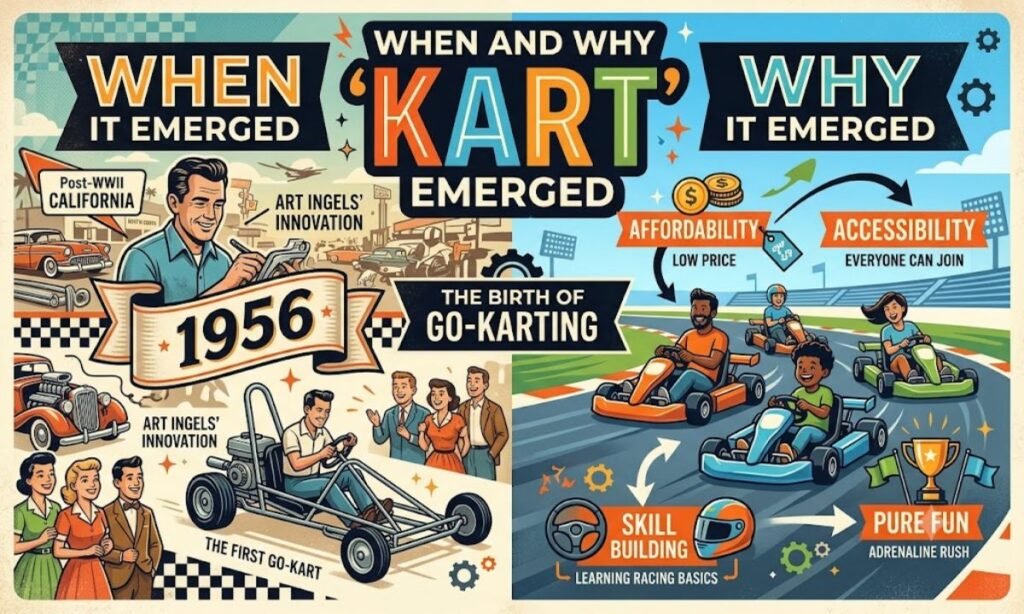
The “k” spelling wasn’t an accident — it was a deliberate branding choice. Before go-karts existed, “go-cart” already referred to baby walking frames from the 1600s. When Art Ingels and other early racing enthusiasts built small recreational racers in the 1950s, using “kart” instead of “cart” helped separate this new, exciting motorsport from the old-fashioned baby item and from ordinary transport carts. The spelling gave the sport its own identity — modern, energetic, and distinct.
Common Mistakes People Make
Even confident writers slip up with cart and kart. Here are the most frequent errors:
- Writing “go-cart” instead of “go-kart” when referring to racing vehicles
- Using “kart” for a shopping cart (e.g., “add it to your kart”) — incorrect in standard usage
- Assuming “cart” and “kart” are just regional spelling variants (they’re not — they refer to entirely different objects)
- Confusing “kart” with unrelated homophones like “chart” or “cartel” in fast typing
A quick proofread — or the “carry vs kinetic” trick above — solves most of these instantly.
Cart vs Kart in Different Industries
The word you need often depends on the industry you’re writing or speaking about:
- Retail & E-commerce: Always “cart” — shopping cart, cart abandonment, checkout cart
- Hospitality: “Cart” — luggage cart, housekeeping cart, room service cart
- Healthcare: “Cart” — medical cart, crash cart, supply cart
- Motorsport & Recreation: “Kart” — go-kart, karting circuit, kart racing league
- Gaming: “Kart” — kart racing games, in-game kart vehicles
- Agriculture & Logistics: “Cart” — hand cart, farm cart, delivery cart
Shopping Cart or Kart?

It’s always “shopping cart,” never “shopping kart.” Since shopping involves collecting and carrying items, “cart” is the only correct spelling here — in physical stores and on e-commerce websites alike.
Final Words
Cart and kart may sound identical, but their meanings sit worlds apart. A cart carries things — groceries, luggage, medical supplies, or items in your online checkout. A kart races — on tracks, at amusement parks, or across your screen in a video game. Once you connect “cart” with carrying and “kart” with speed, you’ll never second-guess the spelling again. Small distinction, big difference in clarity.
Frequently Asked Questions
Is it “cart” or “kart” for shopping?
It’s always a “cart.” Shopping cart is the correct spelling in both physical stores and online checkout systems.
Is “go-kart” spelled with a C or a K?
It’s spelled “go-kart” with a K. The K spelling was chosen to distinguish racing vehicles from old-fashioned “go-carts,” which historically meant baby walkers.
What does “kart” mean in gaming?
In gaming, “kart” refers to the small racing vehicles used in kart-racing games like Mario Kart, staying true to its motorsport origin.
Why does “kart” have a K instead of a C?
The K spelling was intentionally adopted in the 1950s to give go-kart racing its own modern identity and avoid confusion with the older “go-cart” (baby walker) term.

About MeaningsRoot.com
At MeaningsRoot, we make words easy to understand. Our mission is to explain meanings, slang, phrases, and language concepts in simple, accurate, and reader-friendly articles that help you learn with confidence.