

English has a habit of throwing curveballs, and few pairs cause as much confusion as vicious vs viscous. These two words look almost identical, sound somewhat alike when read quickly, and both end in “-ous.” Yet their meanings sit at opposite ends of the language spectrum — one describes cruelty, the other describes a physical property of liquids.
If you’ve ever typed “vicious liquid” instead of “viscous liquid,” or described a dog as “viscous” instead of “vicious,” you’re not alone. This guide breaks down everything you need to know: definitions, origins, real-world examples, synonyms, and the simple tricks that will help you never mix them up again.
What Does Vicious Mean?

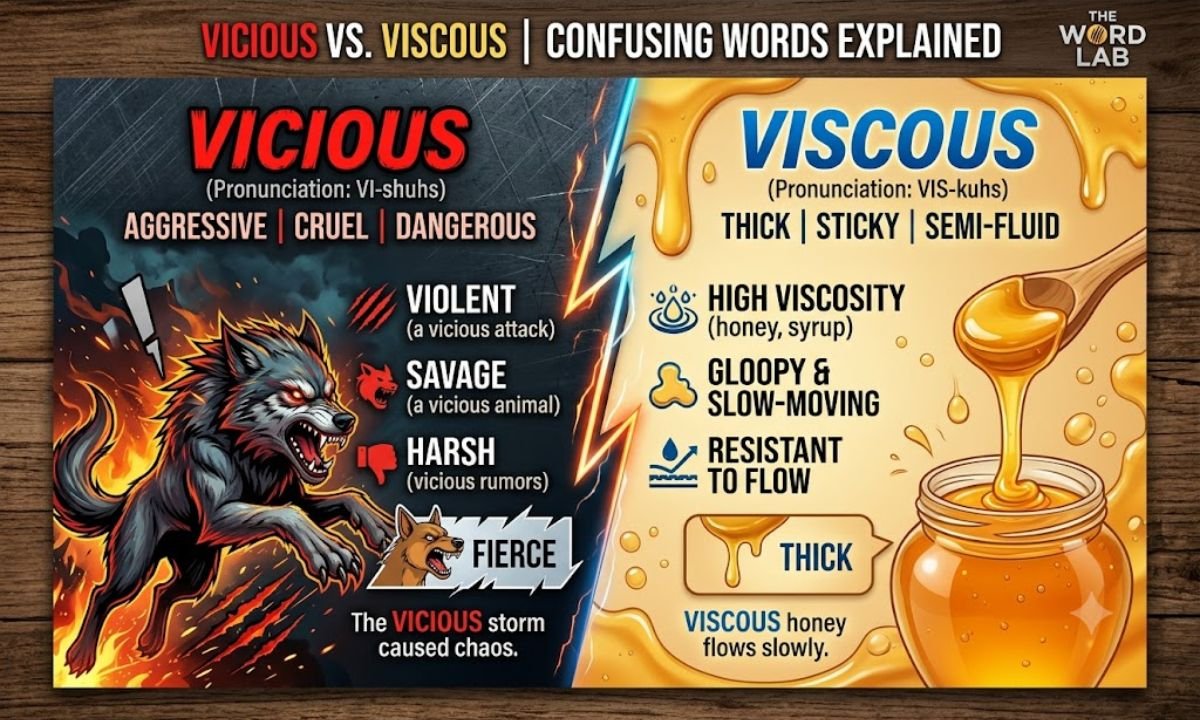
Vicious is an adjective used to describe behavior, actions, or creatures that are cruel, violent, or intentionally harmful. It carries a strong negative, aggressive tone and is almost always tied to emotion, intent, or danger rather than physical texture.
Vicious as Adjective:
- Deliberately cruel, violent, or ferocious
- Malicious or spiteful in nature
- Marked by dangerous aggression (often used for animals)
- Severe or intense (as in a vicious storm or vicious headache)
Examples in sentences:
- The guard dog gave a vicious growl before lunging at the fence.
- Her vicious remarks left the entire room in stunned silence.
- They were caught in a vicious cycle of debt that seemed impossible to escape.
- The boxer landed a vicious uppercut in the final round.
Notice that “vicious” almost always attaches itself to behavior — a person’s words, an animal’s temperament, or an event’s intensity. It’s emotional and forceful, not physical or textural.
What Does Viscous Mean?

Viscous is an adjective that describes a liquid’s resistance to flow. In simple terms, a viscous substance is thick, sticky, and slow-moving compared to a thinner liquid like water. This word shows up constantly in science, cooking, engineering, and product descriptions.
Viscous as Adjective:
- Thick and sticky in consistency
- Slow-flowing due to high internal friction
- Commonly used to describe honey, syrup, oil, lava, or molasses
- Frequently paired with the noun “viscosity” in technical writing
Examples in sentences:
- The honey was so viscous it barely moved when tilted.
- Engine oil needs to remain viscous enough to lubricate moving parts under heat.
- Molten lava is a viscous substance that flows slowly down a volcano’s slope.
- The chef let the caramel sauce thicken into a viscous glaze.
Viscous vs Non-Viscous
Understanding viscosity is easier when you compare it directly to substances that flow easily.
| Feature | Viscous Liquids | Non-Viscous (Low-Viscosity) Liquids |
| Flow speed | Slow | Fast |
| Internal friction | High | Low |
| Examples | Honey, motor oil, molasses, ketchup | Water, alcohol, gasoline |
| Pouring behavior | Sticks to container, forms slow streams | Pours freely and quickly |
| Common use context | Lubricants, syrups, sealants | Beverages, fuels, cleaning agents |
In short: the higher the viscosity, the “thicker” and slower-moving the liquid behaves.
Why Do People Confuse Vicious and Viscous?
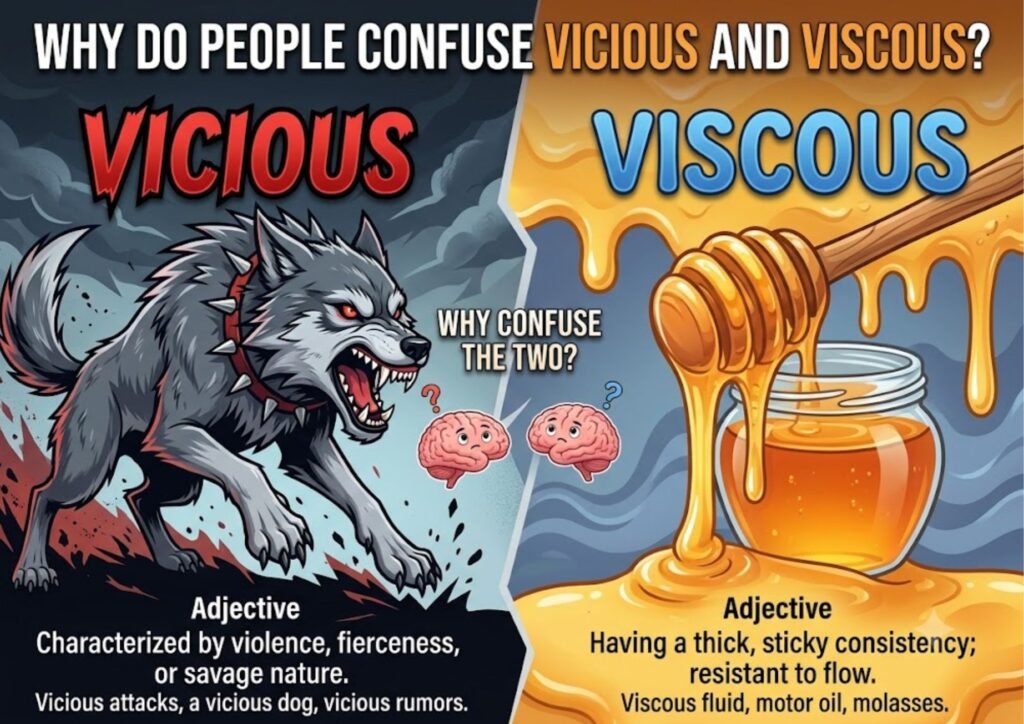
The mix-up between these two words is one of the most common spelling confusions in English, and there are clear reasons behind it.
- Visual similarity – Both words share the same starting letters (vi-), the same ending (-ous), and a similar overall length.
- No shared pronunciation cues – Despite looking alike, they aren’t true homophones, but their similar rhythm makes them easy to mishear or misspeak.
- Autocorrect confusion – Spellcheckers often suggest the wrong word when a typo occurs, since both are valid dictionary entries.
- Unrelated etymology, similar shape – “Vicious” traces back to the Latin vitium, meaning “vice” or “fault.” “Viscous” comes from viscum, referring to a sticky substance once extracted from mistletoe. Despite the shared “-ous” ending, their roots have nothing in common.
- Both are adjectives – Since they function the same way grammatically, writers sometimes substitute one for the other without noticing the meaning shift.
Once you understand that one word is about behavior and the other is about texture, the confusion tends to disappear quickly.
Vicious vs Viscous in Real-Life Contexts
Seeing both words in context makes the distinction much clearer.
Vicious in everyday use:
- A vicious dog attack made headlines in the local news.
- Office politics can turn vicious when trust breaks down.
- The reviewer’s comments felt unnecessarily vicious.
Viscous in everyday use:
- The paint was too viscous to spray evenly.
- Doctors monitor how viscous a patient’s blood is during certain treatments.
- The syrup thickened into a viscous coating over the pancakes.
Vicious in Literature and Media
Writers frequently reach for “vicious” to intensify tone and emotion. It appears in descriptions of villains, storms, arguments, and power struggles because it instantly signals danger or cruelty. A “vicious cycle,” a “vicious rumor,” or a “vicious critic” are all common phrases used in journalism, fiction, and film reviews to heighten drama and convey aggression without needing extra explanation.
Viscous in Scientific Papers and Cookbooks

“Viscous” belongs firmly in technical and descriptive writing. Scientists use it to explain fluid dynamics, engineers use it when designing lubricants, and chefs use it to describe how a sauce, batter, or syrup behaves when poured. In cookbooks, phrases like “cook until the mixture becomes viscous” tell the reader exactly what consistency to expect, making it a precise, functional term rather than an emotional one.
Can Vicious and Viscous Ever Be Interchangeable?
No — these words are never interchangeable. They describe entirely different categories of meaning:
- Vicious relates to behavior, temperament, or intensity.
- Viscous relates to a physical, measurable property of liquids.
There is no context where swapping one for the other would be grammatically or logically correct. A “viscous attack” makes no sense, and neither does a “vicious oil spill” (unless you’re describing the cleanup process as harsh, which would be a stretch and still technically incorrect usage). Keeping their categories separate — emotion/behavior versus physical texture — is the safest rule to remember.
Synonyms and Alternatives of Vicious
- Brutal
- Ferocious
- Savage
- Malicious
- Ruthless
- Merciless
- Spiteful
- Aggressive
- Cruel
- Fierce
Synonyms and Alternatives of Viscous
- Thick
- Syrupy
- Sticky
- Gluey
- Gooey
- Dense
- Gelatinous
- Tacky
- Sludgy
- Treacly
Common Mistakes to Avoid

- Mistake: “The wolf had a viscous bite.”
Correct: “The wolf had a vicious bite.” - Mistake: “The sauce turned vicious after simmering.”
Correct: “The sauce turned viscous after simmering.” - Mistake: Relying on autocorrect without double-checking the suggested word.
Fix: Always reread the sentence to confirm the meaning matches — cruelty vs thickness. - Mistake: Using “vicious” to describe a slow-moving liquid because it “sounds similar.”
Fix: Remember: viscous = liquid texture; vicious = harmful behavior. - Quick memory trick: Viscous has a “c” like “consistency” and relates to sticky substances. Vicious relates to vice (bad behavior) — both share the same first letters as their root meaning.
Wrapping Up: The Viscous Nature of Vicious Words
Confusing vicious and viscous is a small mistake with a big impact on clarity. One word carries emotional weight, describing cruelty, aggression, or intensity. The other is a purely descriptive term used to explain how thick or sticky a substance behaves. Once you connect vicious to behavior and viscous to viscosity, the distinction becomes second nature.
Next time you’re proofreading, pause for a second whenever you type either word. Ask yourself: am I describing an action or attitude (vicious), or am I describing a liquid’s thickness (viscous)? That one question will keep your writing accurate, professional, and free of embarrassing typos.
Frequently Asked Questions
What is the simplest way to remember the difference between vicious and viscous?
Vicious relates to behavior or cruelty, while viscous relates to a liquid’s thickness. Think “vicious = vice,” and “viscous = viscosity.”
Is “viscous” only used for liquids?
Yes, viscous almost exclusively describes liquids or semi-liquid substances based on their resistance to flow.
Can a person be described as viscous?
No, “viscous” only applies to physical substances, not personalities or behavior. Use “vicious” for people or animals instead.
What is a “vicious cycle”?
A vicious cycle refers to a repeating negative situation where each problem makes the next one worse.
Are vicious and viscous pronounced the same way?
No, they are not true homophones, though their similar spelling often makes them sound alike when spoken quickly.
Which word is more common in scientific writing?
Viscous is far more common in scientific and technical writing, especially in physics, chemistry, and engineering contexts involving fluids.
Can “vicious” describe weather or storms?
Yes, “vicious” can describe intense or severe weather, such as a “vicious storm” or “vicious heatwave.”
Does autocorrect commonly mix up these two words?
Yes, spellcheckers frequently suggest the wrong word for typos involving these terms, so manual proofreading is recommended.

About MeaningsRoot.com
At MeaningsRoot, we make words easy to understand. Our mission is to explain meanings, slang, phrases, and language concepts in simple, accurate, and reader-friendly articles that help you learn with confidence.