
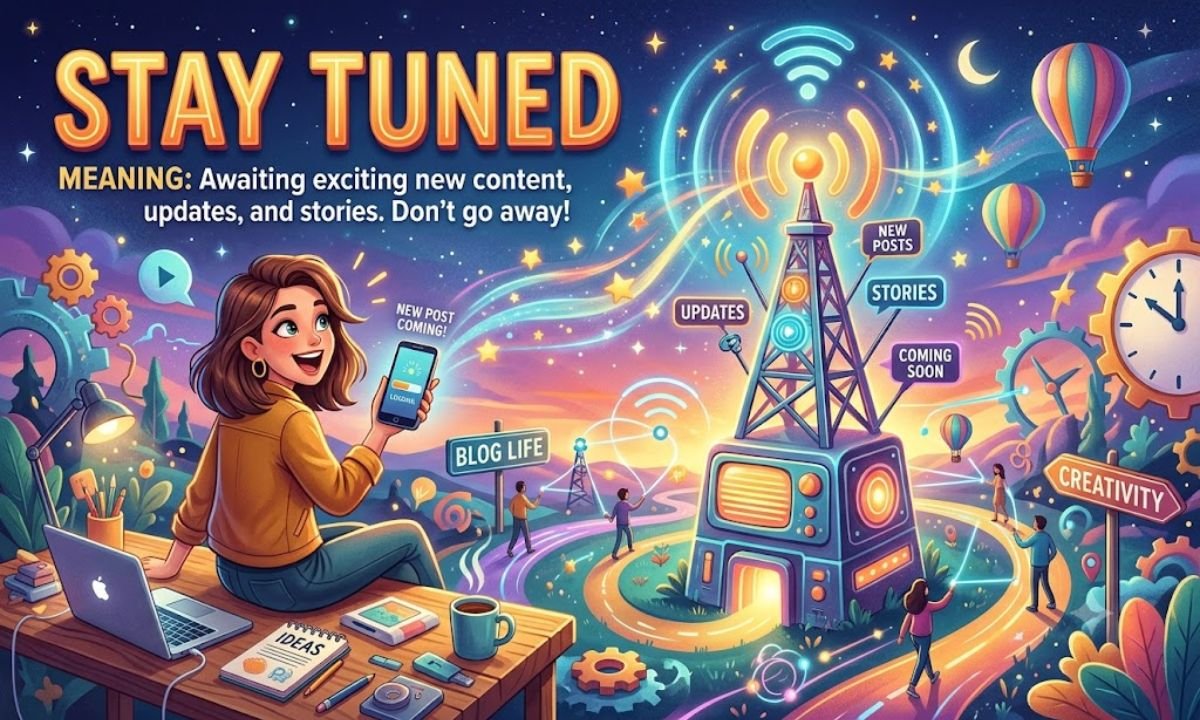

If you’ve ever watched a TV show end with “stay tuned for more,” you’ve encountered one of the most common phrases in the English language. But what does “stay tuned” actually mean, where did it come from, and how can you use it correctly in everyday conversation, writing, or business communication? This guide breaks it all down in simple, practical terms.
What Does “Stay Tuned” Mean?
At its core, “stay tuned” is an idiom that means to keep watching, listening, or paying attention because more information is coming soon. It traditionally means to keep watching a television show or listening to a radio broadcast, and it’s often used figuratively today. Merriam-Webster
In modern usage, “stay tuned” has expanded well beyond television and radio. It’s commonly used to mean continuing to watch or listen to something currently in progress, but the figurative sense now covers almost any situation where updates are expected. Dictionary.com
So whether it’s a news anchor, a brand on social media, or a coworker updating a team, “stay tuned” simply means: don’t go anywhere, something is coming.
Stay Tuned Definition (Quick Snapshot)
| Aspect | Explanation |
| Part of speech | Idiomatic phrase (imperative) |
| Literal meaning | Keep your radio/TV tuned to the current channel |
| Figurative meaning | Keep paying attention for upcoming news or updates |
| Common usage | Broadcasting, marketing, business, social media, everyday speech |
| Tone | Friendly, anticipatory, informal-to-neutral |
The Origin of “Stay Tuned”
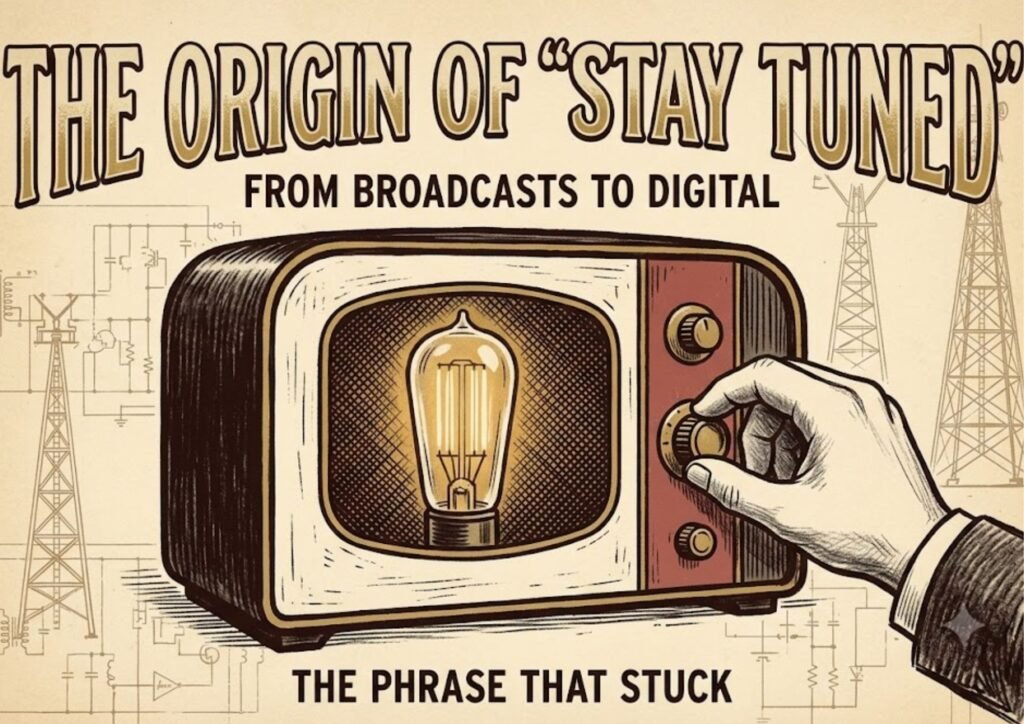
The phrase comes directly from the early days of radio and television broadcasting. Back when tuning a set required manually adjusting a dial, broadcasters wanted to keep audiences from switching stations during commercial breaks or between segments. The phrase essentially told listeners not to change the channel or station they were currently tuned to. Quora
Before remote controls existed, changing the channel meant getting up and physically turning a dial — a bigger commitment than a click of a button today. “Stay tuned” became an idiomatic way to ask people to pay attention to something in the future, rooted in early radio and television culture, specifically to discourage viewers from switching away. Quora
Over the decades, as television and radio became less “dial-dependent,” the phrase stuck around — but its meaning shifted from a literal instruction into a general expression of anticipation.
Stay Tuned in a Sentence
Seeing the phrase in context makes it easier to understand and use naturally. Here are some real-world style examples:
- “Stay tuned for a news update later tonight.”
- “The team is finalizing the announcement — stay tuned!”
- “Stay tuned for a new and improved version of the app.”
- “We can’t share details yet, but stay tuned for something big.”
- “Stay tuned to this page for the latest scores.”
Notice that in almost every example, “stay tuned” is followed by “for” or “to,” pointing toward what’s coming next.
Stay Tuned Meaning in Business
In a business or marketing context, “stay tuned” is a favorite phrase because it builds anticipation without giving away details. Companies use it to:
- Tease upcoming product launches without revealing specifics
- Keep customers engaged between announcements
- Build suspense around sales, discounts, or events
- Maintain audience attention on social media and newsletters
- Signal transparency — showing that more communication is coming
For example, a brand might post: “We’ve been working on something new. Stay tuned — you won’t want to miss this.” This creates curiosity and encourages people to keep checking back, which is exactly the psychological effect marketers want.
Why Businesses Love This Phrase

| Business Goal | How “Stay Tuned” Helps |
| Increase engagement | Encourages repeat visits or follows |
| Build hype | Creates anticipation before a launch |
| Maintain trust | Signals communication is ongoing |
| Save details for later | Avoids premature disclosure |
Something Exciting Is Just Around the Corner
Part of what makes “stay tuned” so effective is the implied promise behind it. It suggests that whatever’s coming is worth waiting for. This is why it pairs so naturally with phrases like:
- “Something exciting is just around the corner.”
- “Big news is on the way.”
- “You’ll want to see this.”
These phrases work together to create anticipation — a key psychological trigger that keeps audiences emotionally invested.
Keep Checking Back for Updates
“Stay tuned” often functions as a polite, energetic way of saying “keep checking back for updates.” Instead of sounding demanding, it feels like an invitation. That’s part of why it’s so widely used in:
- Blog posts awaiting follow-up content
- Product pages before a launch
- Email newsletters teasing future issues
- Social media captions building a content series
Stay Tuned, Coming Soon
You’ve probably seen “stay tuned” paired with “coming soon” on websites, product pages, or app store listings. While similar, they serve slightly different purposes:
| Phrase | Primary Use |
| Stay tuned | Encourages ongoing attention over time |
| Coming soon | Announces a specific upcoming release or event |
Used together — “Coming soon. Stay tuned!” — they reinforce each other: one signals what’s coming, the other encourages watching for it.
Keep Your Eyes Peeled

“Keep your eyes peeled” is a close cousin to “stay tuned,” but with a slightly different flavor. While “stay tuned” implies passive attentiveness (waiting for an update to arrive), “keep your eyes peeled” suggests active watchfulness — scanning for something that might appear unexpectedly.
Both phrases work well in casual or promotional writing, and they’re often used interchangeably to keep language varied and engaging.
Stay Tuned Pronunciation
Pronunciation is straightforward, but here’s a simple breakdown for clarity:
- Stay — /steɪ/ (rhymes with “day”)
- Tuned — /tuːnd/ (rhymes with “mooned”)
Together: “stay toond” — spoken as one smooth phrase, with slightly more emphasis on “tuned.”
Why “Stay Tuned” Works
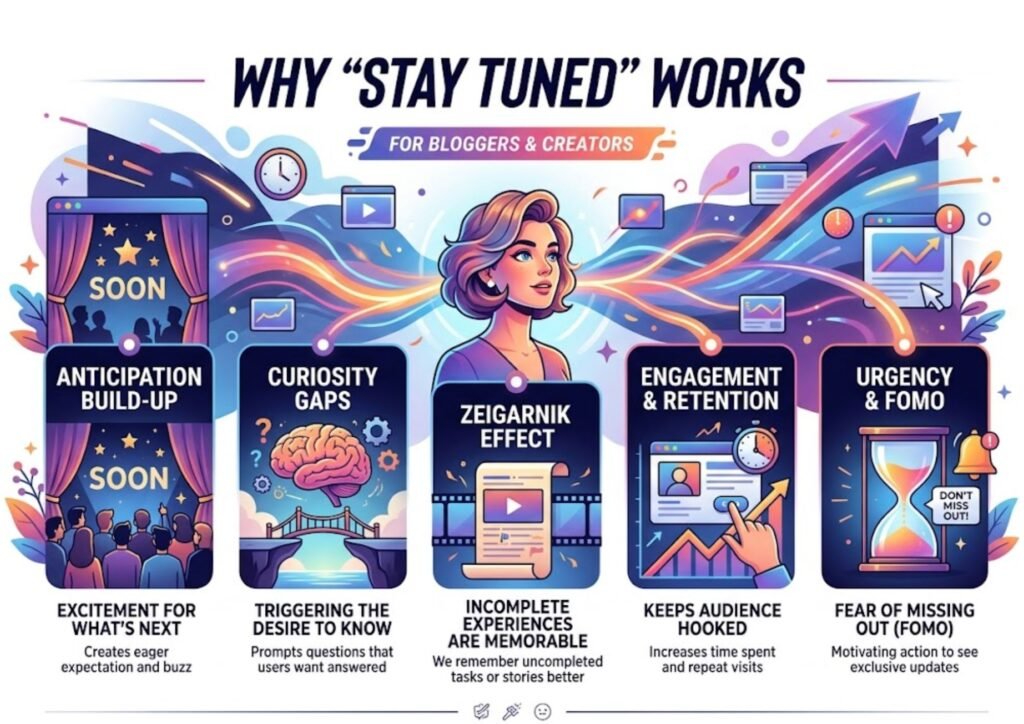
The phrase remains popular because it hits several communication goals at once:
- It’s short and memorable — easy to say and easy to understand instantly
- It builds curiosity — without over-explaining
- It feels friendly — more inviting than “wait for updates”
- It’s versatile — works in casual chats, marketing copy, and news broadcasts alike
- It has emotional pull — implying that what’s coming is worth the wait
Common Mistakes to Avoid
Even simple idioms can trip people up. Here are frequent errors to watch for:
Using “Stay Tune” Instead of “Stay Tuned”
The correct form always includes the “-ed” ending: “tuned,” not “tune.” “Stay tune” is grammatically incorrect, even though it’s a common typo.
Overusing It in Professional Writing
While great for marketing and casual updates, overusing “stay tuned” in formal business reports or official communications can feel vague or unprofessional. Use it sparingly in formal contexts.
Leaving Out What’s Coming
“Stay tuned” works best when paired with at least a hint of context — for example, “stay tuned for our Q3 results” is stronger than “stay tuned” on its own with no follow-up.
Using It Without Ever Following Up

If you tell your audience to “stay tuned,” make sure you actually deliver the promised update. Repeated unfulfilled teasers can erode trust.
Final Thoughts
“Stay tuned” has evolved from a literal broadcasting instruction into one of the most versatile phrases in modern English. Whether you’re writing marketing copy, chatting with friends, or building anticipation for a product launch, understanding its meaning, origin, and correct usage helps you use it more effectively and naturally.
The next time you want to keep your audience engaged without revealing everything upfront, remember: a well-placed “stay tuned” can do a lot of work in just two simple words.
Frequently Asked Questions
What does “stay tuned” mean in texting?
It means the same as in speech — pay attention because an update or reply is coming soon.
Is “stay tuned” formal or informal?
It’s mostly informal to neutral, common in marketing and casual speech but used sparingly in formal writing.
Where did “stay tuned” originate?
It comes from early radio and TV broadcasting, when audiences were asked not to change the channel.
Can “stay tuned” be used in business emails?
Yes, especially in marketing or update emails, though it should be used sparingly in formal reports.
What’s a synonym for “stay tuned”?
Common alternatives include “keep an eye out,” “watch this space,” and “keep checking back.”

About MeaningsRoot.com
At MeaningsRoot, we make words easy to understand. Our mission is to explain meanings, slang, phrases, and language concepts in simple, accurate, and reader-friendly articles that help you learn with confidence.